
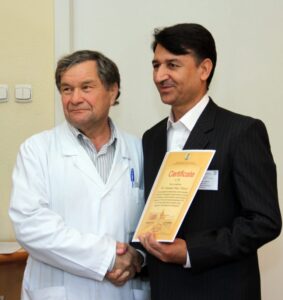
Joint pain, morning stiffness, and swelling should not define your life. At OAIC Peshawar, Dr. Muhammad Inam Khan — holding a formal Certificate in Rheumatology — provides expert diagnosis and treatment for all types of arthritis including osteoarthritis, rheumatoid arthritis, gouty arthritis, psoriatic arthritis, and soft tissue rheumatism.
Types of Arthritis
Years Experience
Specialist Certificates
Patients Treated
Wear & tear — knees, hips, hands
Autoimmune — multiple joints
Uric acid crystals — big toe, ankles
Skin & joint inflammation
Tendons, ligaments, bursae
Dr. Muhammad Inam Khan · FCPS · MRCS Edinburgh & Glasgow
Arthritis literally means inflammation of a joint. It is not a single disease — there are over 100 types of arthritis and related conditions, all of which cause joint pain, stiffness, and swelling that can progressively limit mobility and quality of life. In Pakistan, arthritis — particularly osteoarthritis and rheumatoid arthritis — is among the most common reasons for orthopaedic consultations.
Many patients in Peshawar and KPK suffer silently from arthritis for years, attributing their joint pain to “old age” or “everyday aches.” This is a mistake. Without proper diagnosis and timely treatment, arthritis progressively damages the joint, leading to deformity, loss of function, and eventually the need for joint replacement surgery. Early intervention leads to dramatically better outcomes.
At OAIC Peshawar, Dr. Muhammad Inam Khan holds a formal Certificate in Rheumatology — making him uniquely qualified among Peshawar’s orthopaedic surgeons to manage both the joint damage (orthopaedic aspect) and the underlying inflammatory or metabolic disease (rheumatological aspect) of arthritis. This dual expertise allows for truly comprehensive arthritis care under one roof.
Types of arthritis & related conditions
People affected by arthritis globally
Of osteoarthritis patients are over 55 years old
Of osteoarthritis patients are women
Mon–Fri: 4:00 PM – 7:30 PM
Sun: 12:00 PM – 4:00 PM
Saturday: 9:00 AM – 7:00 PM
Correct identification of your arthritis type is essential — different types have different causes, affected joints, and require very different treatments. Dr. Inam Khan diagnoses accurately before treating.
The most common type of arthritis. Osteoarthritis occurs when the protective cartilage that cushions your joint surfaces gradually breaks down, causing bones to rub against each other. This leads to pain, stiffness, and reduced movement — most often affecting the knees, hips, hands, and spine. It worsens with age, obesity, and previous joint injuries.
Also known as: Degenerative joint disease →
An autoimmune disease where the body's immune system mistakenly attacks the synovial membrane lining the joints, causing inflammation, pain, and swelling. Unlike osteoarthritis, RA typically affects multiple joints symmetrically (both hands, both knees) and causes severe morning stiffness lasting over an hour. It can also affect the heart, lungs, and eyes.
Gout occurs when excess uric acid in the blood forms sharp crystals that deposit in joints, causing sudden, intense attacks of severe joint pain, redness, and swelling — classically in the big toe, but also ankles, knees, and wrists. Gout attacks often come on at night and can be debilitating. Diet, dehydration, and certain medications can trigger attacks.
Psoriatic arthritis affects some people who have psoriasis — a condition characterised by red, scaly skin patches. Joint inflammation causes pain, stiffness, and swelling, sometimes with finger or toe swelling (dactylitis) and nail changes. It can affect any joint in the body. Early treatment is essential to prevent progressive joint damage.
Also known as: Degenerative joint disease →
A group of conditions causing pain and dysfunction in the soft tissues around joints — tendons, ligaments, bursae, and muscles — rather than within the joint itself. Includes tendinitis, bursitis, fibromyalgia, and related conditions. Pain is often localised but can be widespread. OAIC specialises in accurate diagnosis and management of all soft tissue rheumatic conditions.
There are over 100 types of arthritis. Other conditions treated at OAIC include ankylosing spondylitis (spine inflammation), reactive arthritis (triggered by infection), juvenile arthritis (in children and adolescents), septic arthritis (joint infection), and post-traumatic arthritis (following injury to a joint).
Arthritis symptoms vary by type but share common warning signs. If you experience any of the following persistently, seek specialist evaluation at OAIC Peshawar.
Persistent pain in one or multiple joints — aching, burning, or stabbing — especially during or after movement. The hallmark symptom of all forms of arthritis.
Joints feel stiff, tight, or difficult to move after rest or sleep. In rheumatoid arthritis, morning stiffness lasts over an hour. In osteoarthritis, it usually passes within 30 minutes.
Visible swelling, warmth, or redness around an affected joint — indicates active inflammation and requires urgent specialist assessment, especially in younger patients.
Difficulty bending, straightening, or fully moving an affected joint — making it hard to perform daily activities like walking upstairs, getting up from a chair, or gripping objects.
A grating, crackling, or grinding sensation or sound when moving a joint — especially the knee. Common in osteoarthritis as cartilage wears down and bones rub together.
Because different types of arthritis require very different treatments, accurate diagnosis is critical. Dr. Inam Khan uses a structured process to identify your exact arthritis type.
Dr. Inam Khan begins with a thorough history — which joints are affected, how pain started, morning stiffness duration, family history, associated skin or systemic symptoms, and any previous treatments tried.
A systematic examination of all affected joints for swelling, warmth, tenderness, range of motion, deformity, and crepitus. The pattern of joint involvement often reveals the arthritis type immediately.
Blood tests check for inflammatory markers (ESR, CRP), rheumatoid factor (RF), anti-CCP antibodies, uric acid levels (for gout), full blood count, and other relevant markers to confirm or exclude specific arthritis types.
X-rays show joint space narrowing, bone changes, and cartilage loss. MRI provides detailed images of cartilage, synovium, tendons, and soft tissue — essential for early rheumatoid arthritis and soft tissue rheumatism diagnosis.
Once the arthritis type and severity are confirmed, Dr. Inam Khan designs a personalised, evidence-based treatment plan — covering medications, injections, physiotherapy, and surgical options where relevant.
Blood markers specific to rheumatoid arthritis — help confirm RA diagnosis and assess disease activity and joint damage risk.
Elevated uric acid confirms gouty arthritis diagnosis and guides urate-lowering treatment to prevent future gout attacks.
Erythrocyte sedimentation rate and C-reactive protein indicate the level of inflammation — elevated in rheumatoid arthritis, psoriatic arthritis, and active gout.
Assesses joint space narrowing, cartilage loss, osteophyte (bone spur) formation, and joint alignment — crucial for staging osteoarthritis severity.
Detects early synovial inflammation, cartilage damage, bone marrow oedema, and soft tissue changes not visible on X-ray — essential for early RA diagnosis.
Aspiration of joint fluid can confirm gout (uric acid crystals), septic arthritis (infection), or differentiate inflammatory from non-inflammatory arthritis.
Alongside specialist treatment, these lifestyle adjustments can significantly reduce arthritis pain and slow joint damage progression.
Swimming, walking, and cycling keep joints mobile and strengthen surrounding muscles without stressing damaged cartilage. Aim for 30 minutes, 5 days a week.
Excess body weight dramatically increases joint stress — every extra kg adds 4 kg of pressure to the knees. Losing even 5–10% of body weight can significantly reduce arthritis pain.
A diet rich in omega-3 fatty acids, fruits, vegetables, and whole grains reduces joint inflammation. For gout patients, avoiding red meat, seafood, and alcohol is essential.
Warm compresses before activity ease stiffness. Cold packs after activity reduce swelling and inflammation. Alternating heat and cold can provide significant short-term relief.
Use ergonomic tools, supportive footwear, and assistive devices to reduce joint stress. Avoid activities that cause repetitive joint loading or acute pain.
Drinking plenty of water helps flush uric acid from the body, reducing gout attack risk. Aim for at least 8–10 glasses of water per day if you have gouty arthritis.
Adequate rest allows inflamed joints to recover. Good sleep quality reduces inflammation markers. A supportive mattress and joint-friendly sleep positions help reduce morning stiffness.
Arthritis is a chronic condition requiring ongoing monitoring. Regular reviews with Dr. Inam Khan at OAIC ensure your treatment is adjusted as your condition evolves.
Osteoarthritis (OA) is a degenerative condition caused by wear and tear of joint cartilage — most common in older patients, affecting knees, hips, and spine. Rheumatoid arthritis (RA) is an autoimmune disease where the immune system attacks joint linings, causing inflammation across multiple joints simultaneously — often with prolonged morning stiffness over 1 hour. They require completely different treatments. Correct diagnosis at OAIC is the essential first step.
View Page →
View Page →
View Service →
View Service →
View Service →
View Service →
Read Blog →
Read Blogs →
Whether you have osteoarthritis, rheumatoid arthritis, gout, or are unsure of your diagnosis — Dr. Muhammad Inam Khan at OAIC Peshawar can provide accurate diagnosis and the most effective treatment plan. Early treatment protects your joints and preserves your quality of life.
© 2026 OAIC – Orthopaedic Arthroplasty & Ilizarov Clinic Peshawar. All rights reserved.
Pain Specialist Peshawar · Orthopedic Surgeon KPK · Best Pain Doctor Peshawar